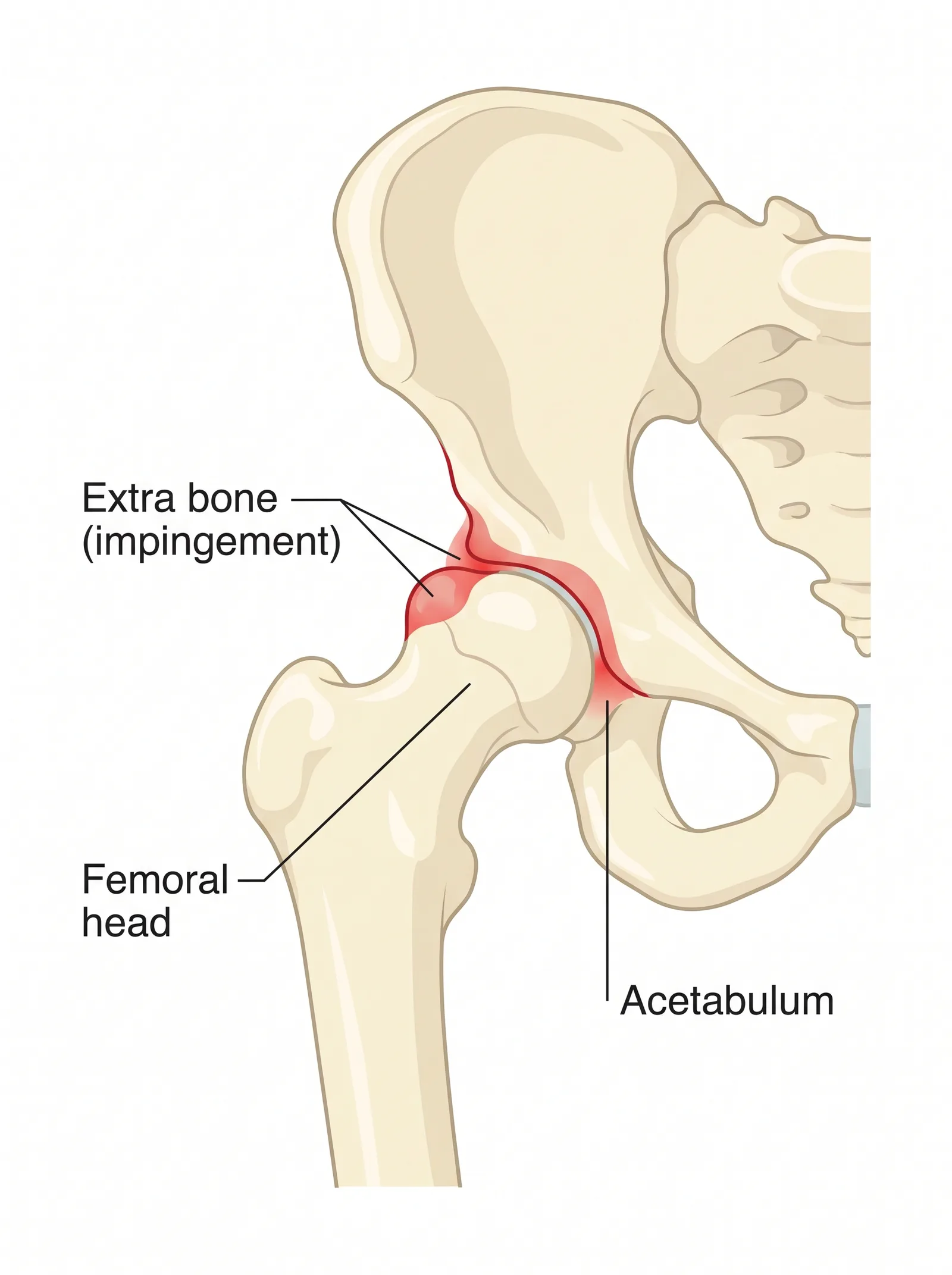
Femoroacetabular impingement, or FAI, is a hip shape where extra bone on the ball, the socket, or both causes the two to pinch during movement. The pinching can damage cartilage and the labrum and cause groin pain, especially with deep bending or pivoting. Care starts with non-surgical steps; surgery is one option when those do not help.
Shariff Bishai diagnoses and treats femoroacetabular impingement (fai) in Troy, from the first visit through recovery.
Who treats femoroacetabular impingement (fai): a complete guide in Troy?
Shariff Bishai is a board certified orthopedic surgeon who treats femoroacetabular impingement (fai): a complete guide in Troy, MI. Fellowship trained at Plancher Orthopaedics and Sports Medicine (orthopedic sports medicine fellowship). Dr. Bishai sees patients at the practice in Troy; appointments can be requested through this site.
What is femoroacetabular impingement?
The hip is a ball-and-socket joint.
Normally the ball, the upper end of the thigh bone, glides smoothly inside the socket, the cup in the pelvis. Femoroacetabular impingement, a term usually shortened to FAI and said "fem-oro-ass-eh-TAB-you-lar," means the bones are shaped so that the ball and socket bump against each other during certain movements instead of gliding freely.
There are three common patterns. In the cam type, extra bone makes the ball less round, so it does not turn smoothly inside the socket. In the pincer type, the socket rim covers too much of the ball, so the two pinch at the edge. Many people have a mix of both, called combined FAI. In each case, the repeated pinching stresses the soft tissues at the rim of the joint.
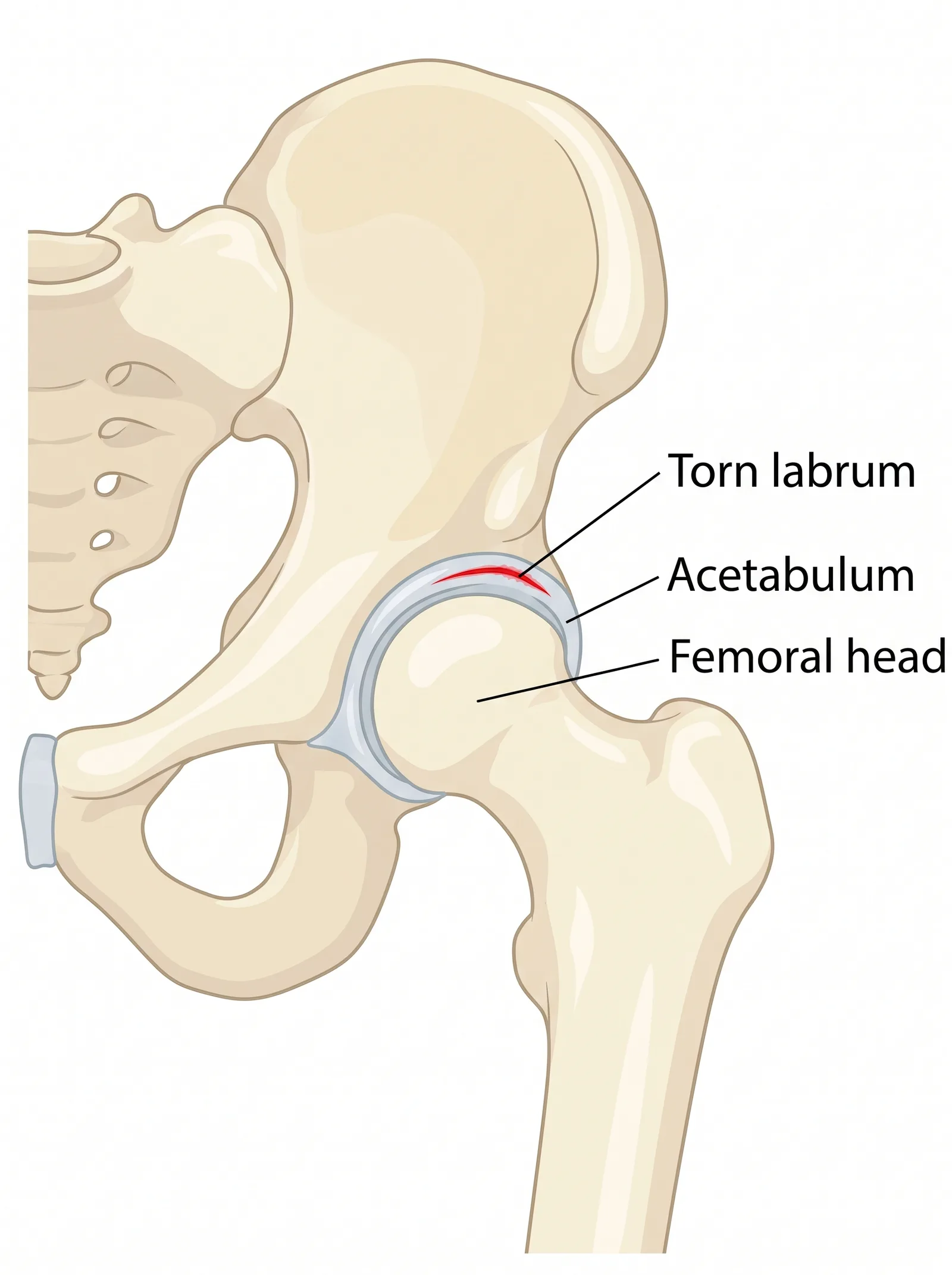
Over time this pinching can fray or tear the labrum, the ring of cartilage that seals the socket, and can wear the smooth cartilage on the joint surfaces. That is why FAI is closely linked to labral tears, which have their own page in this library, and why long-standing FAI can contribute to hip osteoarthritis.
FAI shapes often form during the growing years, which is one reason symptoms can appear in younger and active adults rather than only in older people. Not everyone with an FAI shape has pain. Many people carry these shapes and never notice them. FAI becomes a treatment matter when the shape is causing symptoms and joint stress, and the goal of care is to reduce that stress and calm the joint.
What are the symptoms of Femoroacetabular Impingement (FAI), and when should you see a specialist?
FAI symptoms tend to appear in active adults and often build gradually.
People commonly describe.
- Pain deep in the groin or the front of the hip, sometimes described by cupping the hand into a C shape around the side of the hip, a gesture so common it has a name, the "C sign." - Pain that is worse with deep bending, squatting, pivoting, or twisting, and sometimes with long periods of sitting. - Stiffness or a limited range of motion, especially turning the hip inward. - A catch, click, or pinch deep in the joint with certain movements. - Pain after athletic activity that involves quick changes of direction.
The pain often starts as an occasional ache tied to activity, then becomes more frequent. Many people first notice it in sports or exercise, then find it showing up when they sit for a long drive or a long meeting.
Reasons to see a specialist include groin or front-of-hip pain that has lasted more than a few weeks, pain that limits your sport or daily activity, or catching and stiffness that are not improving. Seeing a specialist early can matter with FAI, because reducing the pinching sooner may help protect the labrum and cartilage. Seeing a specialist does not mean surgery is next. It means getting an accurate diagnosis and starting with the gentlest care.
How is Femoroacetabular Impingement (FAI) diagnosed, and what does the visit involve?
Diagnosing FAI combines your history, a specific exam, and imaging that shows the bone shape.
The visit begins with your story: where the pain sits, which movements bring it on, whether deep bending or long sitting provoke it, and whether you feel pinching or catching. The pattern of pain often points toward impingement.
The exam includes a test where the specialist brings your hip up, in, and rotated, a movement that tends to reproduce the pinching pain of FAI. The specialist also checks your range of motion, since FAI often limits how far the hip turns inward, and watches how you walk.
Imaging is central to an FAI diagnosis, because it shows the bone shapes causing the pinch. X-rays, taken from specific angles, reveal the extra bone on the ball or the socket rim that defines cam and pincer patterns. An MRI, a scan that shows soft tissue in detail, is often added to look at the labrum and cartilage, and a version with contrast dye placed into the joint, called an MR arthrogram, can show a labral tear more clearly. In some cases a CT scan, a detailed bone scan, is used to map the bone shape precisely before surgery.
An honest note: FAI bone shapes are common on imaging in people who have no pain at all. The shape alone does not make the diagnosis. FAI is diagnosed when the shape, the symptoms, and the exam line up. This is why a specialist looks at the whole picture rather than the film by itself.
What does treatment for Femoroacetabular Impingement (FAI) involve?
When FAI symptoms do not settle with non-surgical care, surgery aims to reshape the bone so the ball and socket move without pinching, and to treat any labral or cartilage damage.
This is most often done with hip arthroscopy, a procedure using a small camera and thin instruments through small incisions. This section explains the general sequence. The decision to have surgery, and its details, are made with your surgeon.
- Anesthesia. The procedure is usually done under general anesthesia, meaning you are asleep, sometimes with a regional block for comfort afterward. - Positioning and access. The leg is positioned to open space within the joint. The surgeon makes a few small incisions, called portals, and inserts a small camera called an arthroscope along with slim instruments. - Viewing the joint. The camera lets the surgeon see the ball, the socket rim, the labrum, and the cartilage directly, and confirm where the pinching is happening. - Reshaping the bone. For a cam shape, the surgeon trims the extra bone on the ball to make it round again. For a pincer shape, the surgeon trims the over-covering rim of the socket. For combined FAI, both are addressed. - Treating the labrum. If the labrum is torn, the surgeon repairs it by reattaching it with small anchors, or trims the damaged part, depending on the tissue. - Closing. The instruments are removed and the small incisions are closed. Most people go home the same day.
The aim is to restore a smooth-moving joint and to protect the labrum and cartilage from further pinching. Your surgeon will explain whether the cam shape, the pincer shape, or both apply to you, and what the labral work would involve.
What is the recovery timeline for Femoroacetabular Impingement (FAI)?
Recovery depends on whether you are healing with non-surgical care or after surgery.
For both, progress is measured by what you can do, alongside typical time ranges.
Non-surgical recovery is measured by capability: being able to sit, drive, and do daily tasks without the deep pinch, then returning to activity without a flare. Many people improve over several weeks to a few months of guided care, according to general guidance from the American Academy of Orthopaedic Surgeons. These are ranges, not promises.
Recovery after arthroscopic FAI surgery moves through stages defined by milestones:
- Protected phase: you use crutches and follow motion limits to protect the reshaped bone and any labral repair. This early phase commonly lasts a few weeks. Bone that has been reshaped needs time to be protected from full impact. - Motion and strength phase: with your surgeon's clearance, you move off crutches once you can bear weight comfortably and walk without a limp, and therapy shifts toward restoring strength and full, comfortable motion. This often spans the following weeks to months. - Return-to-activity phase: you return to running, pivoting, and sport when strength, control, and motion meet your surgeon's and therapist's criteria, not simply when a date arrives. Full return to demanding activity commonly takes several months, according to general guidance from the American Academy of Orthopaedic Surgeons. These are ranges, not promises.
Your timeline depends on what was reshaped, whether the labrum was repaired, your health, and your rehabilitation. The criteria matter more than the calendar.
How should you prepare for the visit or the procedure?
Preparing for the visit, if you have not yet been diagnosed: bring the history of your pain, which movements bring it on, what you have already tried, your other health conditions and medications, and your goals in plain terms.
Wear clothing that lets the hip be examined and lets you walk for the gait check. Bring any prior imaging or the name of the place that has it.
Preparing for arthroscopic FAI surgery, if it is planned, involves logistics worth arranging ahead of time:
- Transportation. You cannot drive yourself home after anesthesia. Arrange a driver and, ideally, someone to stay with you the first night. - Crutches and home setup. You will use crutches for a period. Before surgery, clear walking paths, remove loose rugs, and set up a spot on one level with what you need within reach. - Time off. Plan time away from work based on your job. Desk work usually allows an earlier return than work on your feet. Your surgeon can help you estimate. - Help on hand. Have someone available to help with meals, errands, and getting around for the first several days. - Equipment. A stationary bike or a motion machine is sometimes recommended to keep the hip moving gently. Ask whether you will need one and how to arrange it.
If you have insurance questions about the visit, imaging, or a procedure, the office can answer those directly. Prices are handled by the office, not listed here.
Which warning signs should you call about?
After a diagnosis, and especially after surgery, some signs deserve a prompt call.
Call the office if you notice the following.
- Fever, or increasing redness, warmth, or drainage from an incision, which can point to infection. - Calf pain, swelling, or tenderness, especially with warmth, which can signal a blood clot. - New or worsening numbness, tingling, or weakness in the leg or foot. - Pain that is getting worse rather than easing, or that your plan is not controlling. - A hip that locks or will not move.
For chest pain, shortness of breath, or any symptom that feels severe or frightening, seek emergency care right away. For questions about your hip or your recovery, the office is the right first call, and the contact information is on the practice's contact page.
What results can you expect from Femoroacetabular Impingement (FAI)?
Outcomes for FAI depend on the shape, the tissue damage, and whether care is non-surgical or surgical.
- Many people with FAI improve their symptoms with non-surgical care, including activity changes and physical therapy, according to general guidance from the American Academy of Orthopaedic Surgeons, even though the bone shape itself does not change. - When surgery is needed, arthroscopic surgery to reshape the bone and treat the labrum relieves pain and improves function for most appropriately selected patients, according to general information from the American Academy of Orthopaedic Surgeons. - Long-standing, untreated impingement can contribute to cartilage wear and hip osteoarthritis over time, according to general information from the American Academy of Orthopaedic Surgeons, which is part of why addressing symptomatic FAI matters.
These figures describe groups, not a promise for one person. Your hip shape, your tissue, your health, and your rehabilitation all shape your result. Your surgeon can place these ranges in the context of your own hip. These are ranges, not promises.
What do patients ask most?
Is FAI something I was born with?+
Can physical therapy fix the bone shape?+
Is FAI the same as a labral tear?+
Will FAI lead to arthritis?+
How soon can I return to sports after FAI surgery?+
What are the treatment options?
- 01Activity changesReducing or modifying the movements that cause pinching, such as deep squatting, repeated pivoting, and long sitting, often lowers symptoms. This does not mean stopping activity, but adjusting how you do it.
- 02Physical therapyA physical therapist, a movement specialist, can strengthen the muscles around the hip and core, improve how the hip and pelvis move together, and reduce the stress on the joint rim. Therapy is often the core of non-surgical FAI care.
- 03MedicationNonsteroidal anti-inflammatory drugs, often shortened to NSAIDs, can reduce pain and inflammation during flares. They are not right for everyone, so the office can help you weigh them against your health.
- 04InjectionsA corticosteroid injection, a shot of anti-inflammatory medicine into the joint, can calm pain and can also help confirm the hip is the source of the symptoms. Relief is temporary.
How do payments work?
Contact the office to confirm insurance participation.
Fellowship trained at Plancher Orthopaedics and Sports Medicine (orthopedic sports medicine fellowship). Sees patients in Troy.
About Dr. Bishai →