What is Achilles Tendon Injury?
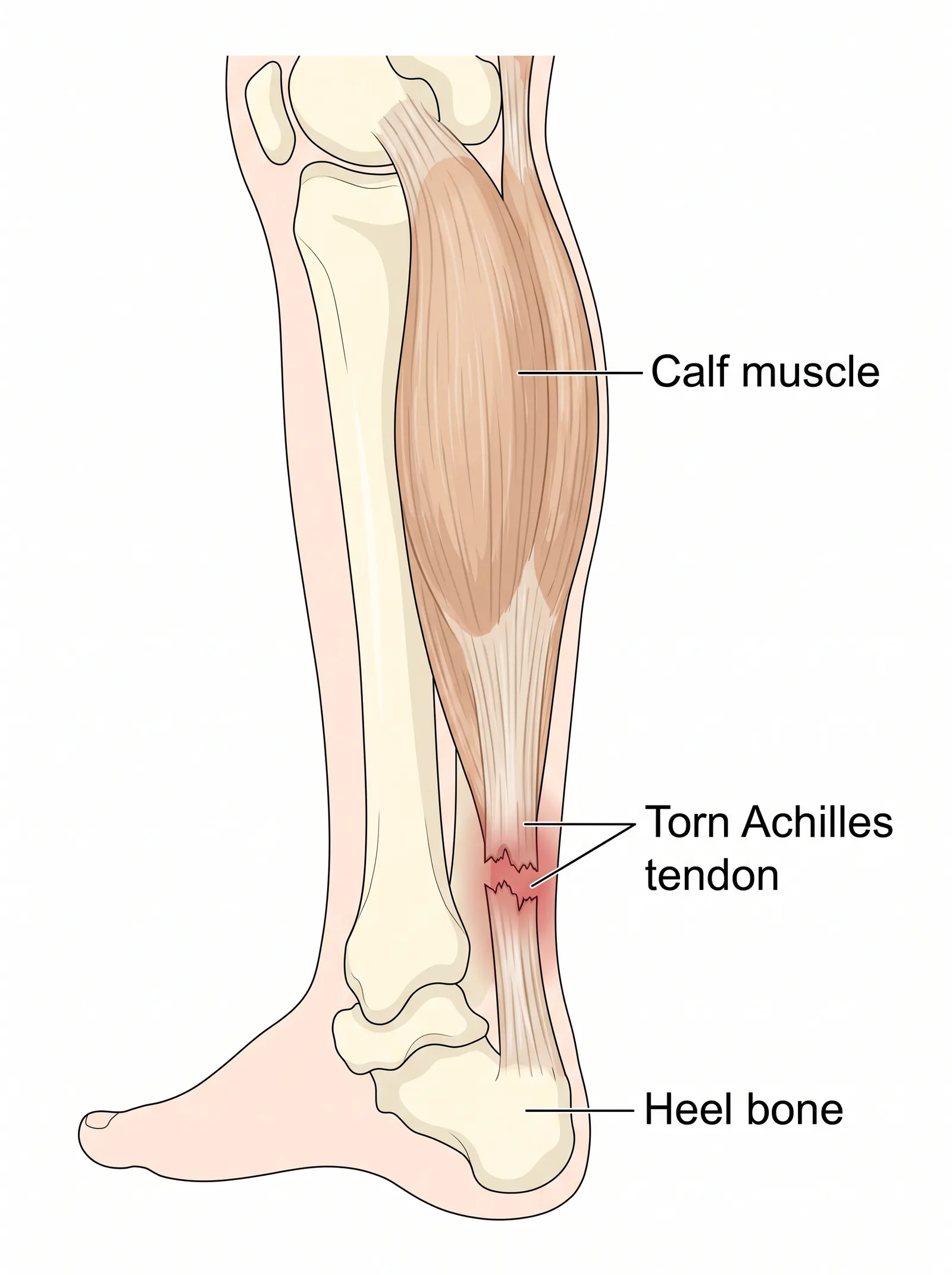
The Achilles tendon (say: uh-KILL-eez) is the strong cord you can feel at the back of your ankle.
It connects your calf muscle to your heel bone. Every time you push off to walk, run, or jump, this tendon carries the load. It is the strongest tendon in the body, but it can still be injured.
Achilles injuries fall along a range. At the milder end is tendinitis (say: ten-din-EYE-tis), which is irritation of the tendon from overuse. In the middle is a partial tear, where some of the fibers give way. At the more serious end is a complete rupture, where the tendon tears fully across, often with a sudden snap.
A complete rupture is a distinct and dramatic injury. Many people describe feeling as if they were kicked or shot in the back of the ankle, sometimes with an audible pop. It often happens during sports that involve quick starts and stops, and it is common in adults between about 30 and 50 years old.
The good news is that Achilles injuries heal, and there are proven paths back to activity. The choices depend on the type of injury and on your goals. This page covers the full range, from irritation to rupture. For a shorter overview of Achilles care at the office of Shariff Bishai, see our Achilles tendon service page.
What are the symptoms of Achilles Tendon Injury, and when should you see a specialist?
Symptoms depend on how badly the tendon is injured, so it helps to describe each situation in plain terms.
For tendinitis and milder strain, you might notice:
- Aching or stiffness along the back of the ankle, worst in the morning. - Pain that flares with activity and eases with rest. - Tenderness or mild swelling along the tendon. - A sense that the tendon is tight.
For a partial or complete tear, you might notice:
- A sudden sharp pain or a snapping feeling at the back of the ankle. - A pop you can hear or feel at the moment of injury. - Trouble pushing off, rising on your toes, or walking normally. - Swelling and bruising at the back of the ankle and heel. - A feeling that the ankle gave way.
A sudden snap with trouble walking is a reason to be seen promptly. A complete rupture is best evaluated soon after it happens, because early diagnosis gives you the most treatment options.
For milder, gradual pain, it is reasonable to try rest first. See a specialist if:
- Tendon pain lasts more than a few weeks despite rest. - You cannot push off or rise onto your toes. - You felt a snap or pop at the moment of injury. - You have significant swelling, bruising, or a gap you can feel in the tendon.
When a sudden Achilles injury happens, getting evaluated quickly matters. The sooner the injury is understood, the more choices you have.
How is Achilles Tendon Injury diagnosed, and what does the visit involve?
Diagnosing an Achilles injury combines your story with a focused exam, and often a simple test that your specialist can do in the room.
When you see Dr. Bishai, the goal is to learn whether the tendon is irritated, partly torn, or fully torn.
Your specialist will ask:
- How and when the injury happened. - Whether you felt or heard a pop. - What you can and cannot do now, such as walking or rising on your toes. - Your activity and any past tendon problems.
The exam includes gently feeling along the tendon for tenderness, swelling, or a gap. A key part is a simple squeeze test of the calf. Normally, squeezing the calf makes the foot point down. If the tendon is completely torn, the foot may not move as expected. This test helps tell a complete rupture from a partial injury.
Imaging is not always needed for a clear rupture, but it can help in uncertain cases. Ultrasound, which is a picture made with sound waves, can show the tendon and any gap. MRI, which is a detailed picture of soft tissue, is used when more information is needed or when planning treatment.
By the end of the visit, you should know the type of injury you have and the treatment options that fit it.
What does treatment for Achilles Tendon Injury involve?
If you and your specialist choose surgical repair for a rupture, here is the general sequence.
The details depend on the technique and your specific injury.
Step 1: Anesthesia. Achilles repair is often done with a nerve block that numbs the leg, sometimes with medicine to help you relax. Your care team will review the plan with you first.
Step 2: Reaching the tendon. The surgeon makes an incision at the back of the ankle to reach the torn tendon. Some surgeons use a smaller incision technique when it fits the injury.
Step 3: Repairing the tendon. The surgeon brings the torn ends together and stitches them securely so the tendon can heal in the right length and tension. Getting the tension right matters for how your calf works afterward.
Step 4: Closing. The incision is closed and the ankle is placed in a splint or boot, usually with the foot pointed down at first to protect the repair.
Step 5: Recovery begins. You go home the same day in most cases. Over the following weeks, the foot is gradually brought toward a neutral position, and weight and motion are added on a schedule your specialist sets.
The procedure typically takes about an hour, though this varies. Your specialist will give you specifics, including how the boot will be adjusted and when therapy begins.
What is the recovery timeline for Achilles Tendon Injury?
Achilles recovery is a staged process whether you have surgery or not, and it is best measured by milestones you reach rather than dates.
The ranges below are typical, not promises.
Milestone 1: Protected in a boot. The tendon is protected, often with the foot pointed down at first, then gradually moved toward neutral. Weight is added on a schedule.
Milestone 2: Walking in the boot, then out of it. As healing allows, you walk more in the boot, then transition out of it into a supportive shoe, often with a heel lift at first.
Milestone 3: Full daily walking and strength work. You can walk normally for daily activities and begin building calf strength through guided therapy.
Milestone 4: Return to running and sport. With enough strength and control, you can gradually return to higher-impact activity. This is the last milestone and should not be rushed.
According to general guidance from the American Academy of Orthopaedic Surgeons, returning to full activity after an Achilles rupture commonly takes several months to about a year, whether treated with surgery or without. These are ranges, not promises. Rebuilding calf strength takes time, and returning to sport too early raises the risk of re-injury.
Your specialist and physical therapist will advance each stage based on how your tendon is healing and how your strength returns, not on the calendar alone.
How should you prepare for treatment?
Whether you are treated with surgery or a boot, an Achilles injury changes how you get around for a while, so planning ahead helps a great deal.
For transportation and time off:
- Arrange a ride home if you are having surgery, since you cannot drive after anesthesia. - Expect not to drive for a while if the injured foot is your driving foot. Ask your specialist when driving is safe again. - Plan time off based on your job. A standing or physical job usually needs more time than a desk job. Your specialist can advise.
For your home setup:
- Prepare a spot to rest with the leg elevated, since keeping the leg up helps control swelling early on. - Keep daily items within easy reach on one level if possible, to reduce trips up and down stairs. - Clear walkways and remove loose rugs, since you will be moving in a boot and possibly using crutches or a knee scooter. - Learn to use your crutches or scooter safely before you need them for a full day.
Ask the office ahead of time about your medicine plan, when to stop eating before surgery if that applies, and what to bring. Practicing getting around your home in the boot before the first busy day makes the transition easier.
Which warning signs should you call about?
Most Achilles recoveries proceed without trouble, but some signs need prompt attention.
Knowing them helps you respond quickly.
Call the office of Shariff Bishai at (248) 952-8080 if you have:
- Increasing pain not controlled by your plan. - Redness, warmth, or drainage from an incision, which can signal infection. - A fever. - A sudden increase in swelling with new pain. - A feeling that the tendon gave way again, or a new pop. - Numbness or a color change in the foot or toes. - A boot or splint that feels too tight.
Some symptoms are urgent. Seek immediate care if you have calf pain and swelling with warmth, chest pain, or trouble breathing, since these can point to a blood clot, a serious risk after leg injury and surgery. If you cannot reach the office and have a worrying symptom, go to urgent care or the emergency room.
If you have diabetes or poor circulation, call sooner for any concern. When in doubt, calling the office is the right choice.
What results can you expect from Achilles Tendon Injury?
Knowing what to expect helps you weigh your choices.
The numbers below come from published guidance, and each is a range, not a promise.
According to general guidance from the American Academy of Orthopaedic Surgeons, most people recover good function after an Achilles rupture with either surgical or non-surgical treatment, and both approaches allow many people to return to their prior activities. These are ranges, not promises, and results depend on the injury, your health, your activity goals, and how closely you follow the recovery plan.
It is honest to add that re-rupture, meaning the tendon tears again, can happen with either treatment, and the risk is lowered by following the staged recovery and not rushing back to sport. Your specialist will discuss how surgical and non-surgical paths compare for your situation, using sourced ranges rather than guarantees.
The balanced summary is this: both treatment paths work well for most people, recovery takes months, and rebuilding strength patiently gives the strongest recovery.
What are the treatment options?
- 01Rest and activity changesCutting back on the activity that flares the tendon while it calms down.
- 02IceApplied after activity to ease pain and swelling.
- 03Stretching and strengtheningA physical therapist can guide exercises. A specific type called eccentric strengthening, which loads the tendon as the muscle lengthens, is often helpful.
- 04A heel liftA small lift inside the shoe can take tension off the tendon for a time.
- 05Anti-inflammatory medicineFor comfort, if your doctor says it is safe for you.
- 06Non-surgical treatmentThe ankle is held in a boot or cast with the foot pointed down at first, then gradually brought back to a neutral position over weeks. This lets the tendon ends heal together. This path avoids surgery and its risks.
- 07Surgical repairThe surgeon stitches the torn ends of the tendon back together. This is often chosen for younger or more active people, though modern non-surgical care has narrowed the differences.
What do patients ask most?
What do patients ask about Achilles Tendon Injury?+
Education and training
Medical school at Michigan State University College of Osteopathic Medicine. Residency at Henry Ford Macomb Hospital. Fellowship at Plancher Orthopaedics and Sports Medicine.
- FellowshipPlancher Orthopaedics and Sports MedicineOrthopedic sports medicine fellowship
- ResidencyHenry Ford Macomb HospitalOrthopedic surgery residency
- Medical schoolMichigan State University College of Osteopathic MedicineDoctor of Osteopathy
- Board statusAmerican Board of Orthopaedic SurgeryBoard certified
- Address1560 E Maple Rd
Suite 120, Troy, MI 48083 - Phone(248) 952-8080